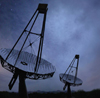
Very Energetic Radiation
Imaging Telescope Array System (VERITAS)
VERITAS is state-of-the-art observatory of very high-energy (VHE) gamma
rays in the energy range between 50 GeV and 50 TeV.
VERITAS consists of four large (12m diameter) reflectors, each viewed
by a camera of 500 photomultiplier tubes (PMTs). Each PMT is read out by a
500 MS/s Flash-ADC. VERITAS has produced many scientific results
so far, including the detection of VHE gamma rays from a
variety of astrophysical sources including pulsar wind nebulae,
supernova remnants, binary systems, active galactic nuclei,
starburst galaxies, and radio galaxies, and very sensitive limits on the annihilation
of WIMP dark matter.
In VERITAS, UCLA has primary responsibility for the
Level 1 Trigger, the Level 3 (multi-Telescope)
Trigger, and the online data storage and archiving facility.
Scientists at UCLA are involved in a broad range of scientic
topics, including Galactic sources, extragalactic sources,
dark matter, and astroparticle physics.
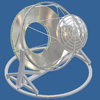
Cherenkov Telescope Array Observatory (CTAO)
CTAO (previously CTA) is a major gamma-ray observatory that will greatly expand
our understanding of the high-energy and very high-energy universe.
Currently in the construction phase, CTAO will consist of two large arrays of atmospheric
Cherenkov telescopes. One array is under construction in the northern hemisphere in Spain (La Palma) and the other is under development in the southern hemisphere in
Chile (Paranal).
CTAO is
a logical follow-up to the VERITAS and Fermi missions that are currently
operational.
UCLA has involvement in many aspects of CTAO, including: overall leadership of the project,
development of the Schwarzschild-Couder,
Telescope (SCT), site evaluation and site development, and science planning and simulations.
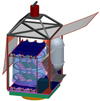
General AntiParticle Spectrometer
(GAPS) Experiment
GAPS is a balloon-borne experiment to search for antideuterons in the
cosmic rays. Antideuterons at energies below 1 GeV are a unique signature
of annihilating weakly-interacting dark matter. GAPS will consist of a large
array of Si(Li) detectors surrounded by a time of flight (ToF) detector. A prototype
instrument (pGAPS) was successfully flown in 2012 and funding for the full science
payload was approved by NASA in 2017.
The GAPS team completed the construction of the science instrument in 2023 and it
was subsequently re-integrated and tested throughout 2024.
GAPS has a current schedule to be flown in Antarctica in late 2025.
UCLA is responsible for the time-of-flight system and the overall GAPS trigger.
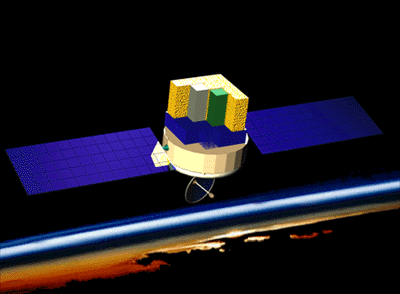
Fermi Gamma-ray Space
Telescope
Fermi is a high-energy gamma-ray satellite launched by NASA on
June 11, 2008.
The Large Area Telescope (LAT) on Fermi has an
energy range between 10 MeV and 300 GeV. The LAT consists of silicon strip detectors
for tracking and a CsI calorimeter for energy measurement.
Fermi is fully operational with many exciting results so far and more to come.
Ong has been an Associate Member of the LAT since its inception.
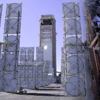
Solar Tower Atmospheric
Cherenkov Effect Experiment (STACEE), Now Completed
STACEE used the atmospheric Cherenkov technique to detect gamma rays
at energies between 50 and 500 GeV. Until recently, this energy
range was not explored by any other experiment. In 1999, a early version
of STACEE detected ~4,800 high-energy gamma rays from the Crab Nebula,
and in 2001, rapid flares of gamma rays were detected from the blazar
Markarian 421. Operating between 2001 and 2007, STACEE carried out
a comprehensive program of observations of galactic and extragalactic
sources. In 2006, STACEE reported spectral measurements of the Crab Nebula
and Markarian 421 at energies between 150 GeV and 1500 GeV. In 2009,
STACEE reported results from observations of 23 gamma-ray bursts, the pulsar
PSR 1951+32, and the Draco dwarf galaxy. UCLA was the lead university on STACEE.